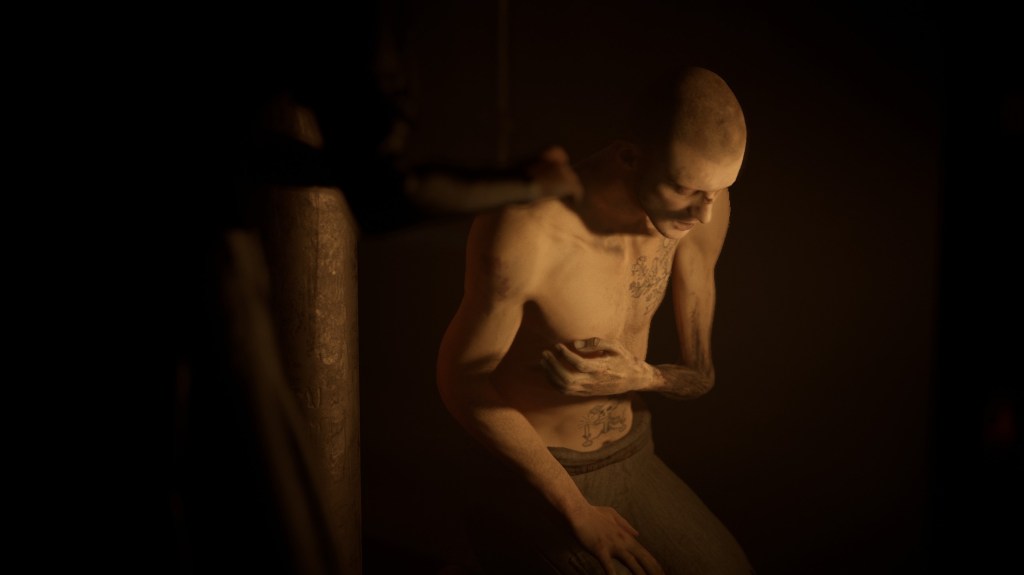
Indika is not the game I thought it would be and I’m grateful for that. I don’t think many games try to address religion and if they do it’s at either a insincere level or treated as set dressing. I was worried that Indika would be more of the former and while it might start out that way, it does pivot to something more interesting. It does attempt a narrative, that while I’ve seen before, I think it hits the mark it was aiming for.

You play as the titular Indika, a nun struggling to fit into her cloister in a skewed version of Russia. I say skewed because everything in the world is exaggerated, dogs are huge hulking beasts, fish are leviathan sized and the world just doesn’t seem to make sense to us, but definitely makes sense to its inhabitants. I always like this type of world building, we don’t have to have everything explained and it can rely on your perception of the real world to make you feel off in the setting.
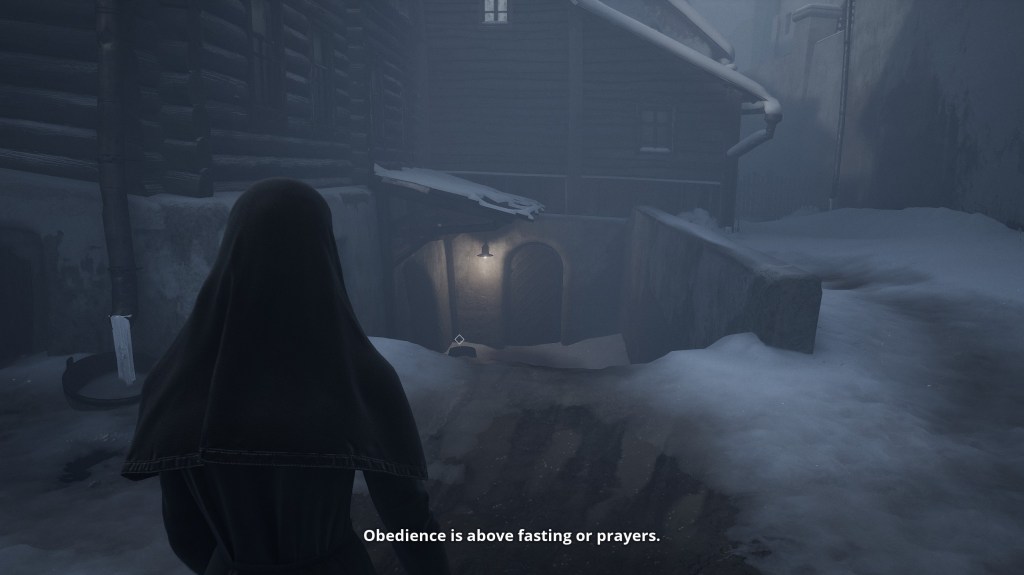
As we start to spend time with Indika we realize definitely does not fit into this cloister, she has a voice in her head feeding her constant doubts and hallucinations, causing issues for her fellow nuns. Eventually she’s sent on a task that sets her onto the story that makes her feel salvation is still possible for her. What I appreciated about the beginning is that Indika isn’t defiant about being a nun, she isn’t flippant about her role. She’s trying her best, but the structure of the cloister isn’t built to support her. None of the other nuns seem to care about her, a part right at the start of the game drove this home where you’re filling a barrel with water from a well. You’ve been tasked to do this, it takes forever, the gameplay loop is mundane and when you finally fill it up, your fellow nun dumps all the water into the freezing snow.
At first, I tried to address the situation in my mind. Is this a commentary at how the task itself is a pseudo-punishment for Indika? Was there was no need for it and was it more to teach Indika to be obedient? I appreciate the gray area here, it could be something to make Indika a more pious nun or it could be that her fellow nuns just don’t like her.
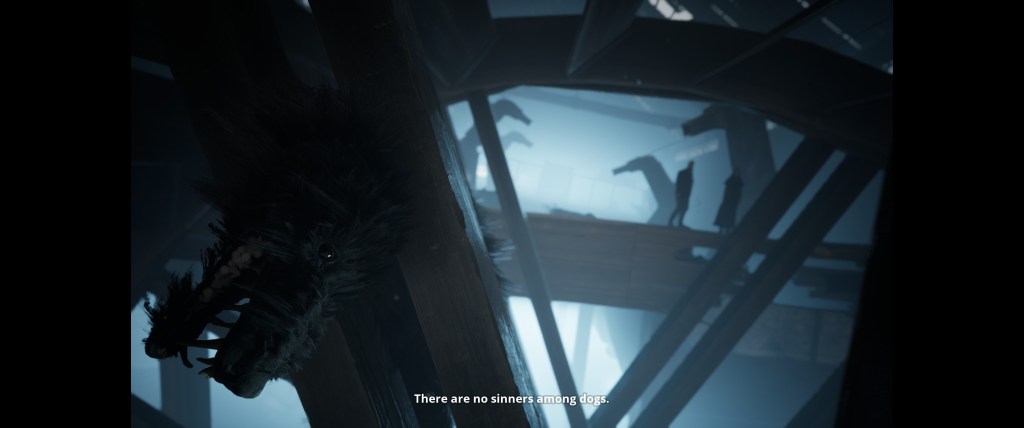
Indika herself is interesting as she is somewhat of a unreliable character. It’s not like she can hide her desires or intentions, you as the player get to see the real truth. But she definitely tries to make herself seem more heroic than she actually is. There’s a scene where Indika is about see violence unfold and she originally plans to do nothing. But due to some story beats, she ends up accidentally getting involved, she doesn’t save the day as she’s more of an accidental distraction. But, crucially, how does she portray this situation to an outside observer? Well, she’s the hero of course, she stepped in when no one else would! But you as the player see the full truth, there’s just nothing you can do about it, you’re just along for the ride.
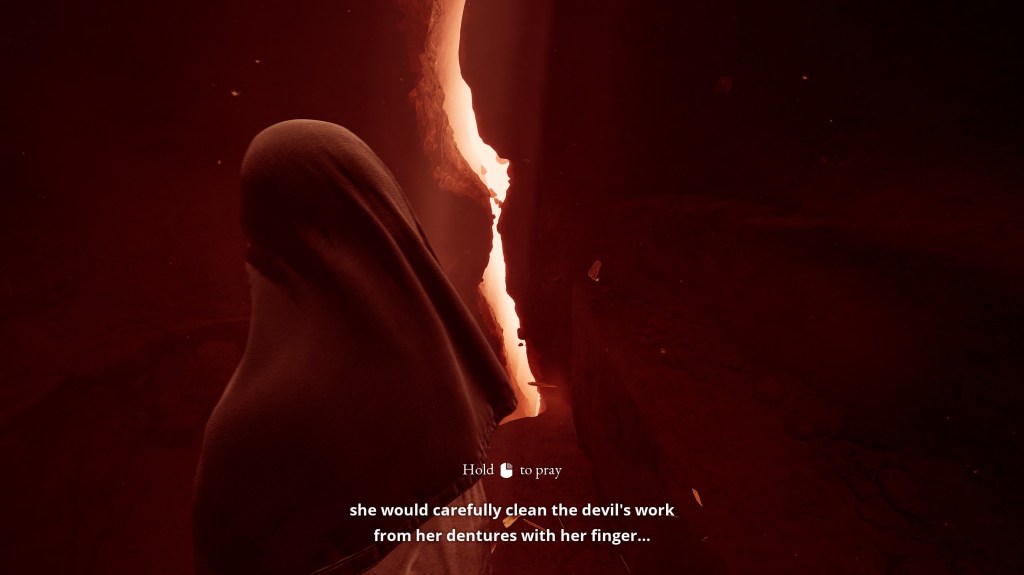
Overall if there was one critique it’s around the voice in Indika’s head, I sort of wished would pop up more in the gameplay. There’s a section that is actually in the demo of the game where Indika comes to a harsh truth and this voice in her head gets to take control for a bit. As this voice speaks to all of Indika’s doubts and fears, the world tears itself apart, making the platforming section impossible. So how does she overcome this issue? She prays. I think this was a very powerful section of showing that praying gives Indika solace, peace and helps literally set her on the right path. Some might call that hamfisted, but I appreciated how it showed how much religion might mean to Indika. The complaint I have is this only happened once and I wanted more of that.
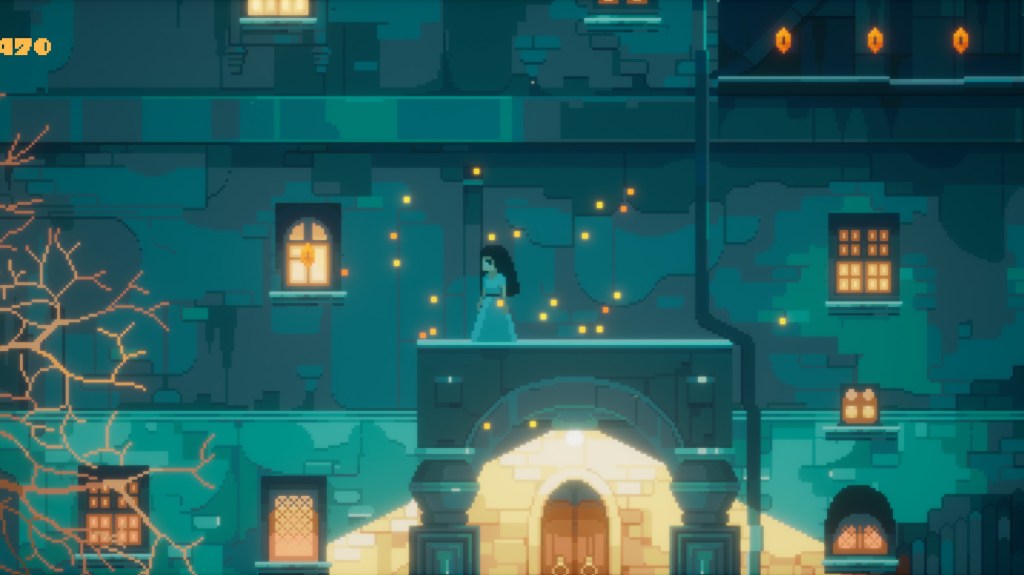
There are beats where you get to see Indika’s past and they play in pixel art form and you see she didn’t grow up to be a nun, she had a normal childhood. I liked the break from the bleak world and saw the developers had fun with this small sections. But I also think it did a good job of drawing you in by saying how did this girl get to the cloister? What happened to put her in a situation where she is now a nun desperately trying to fit in? The way the final section plays out for these flashbacks changes your perspective on Indika and maybe that she has flaws that have nothing to do with her struggles.
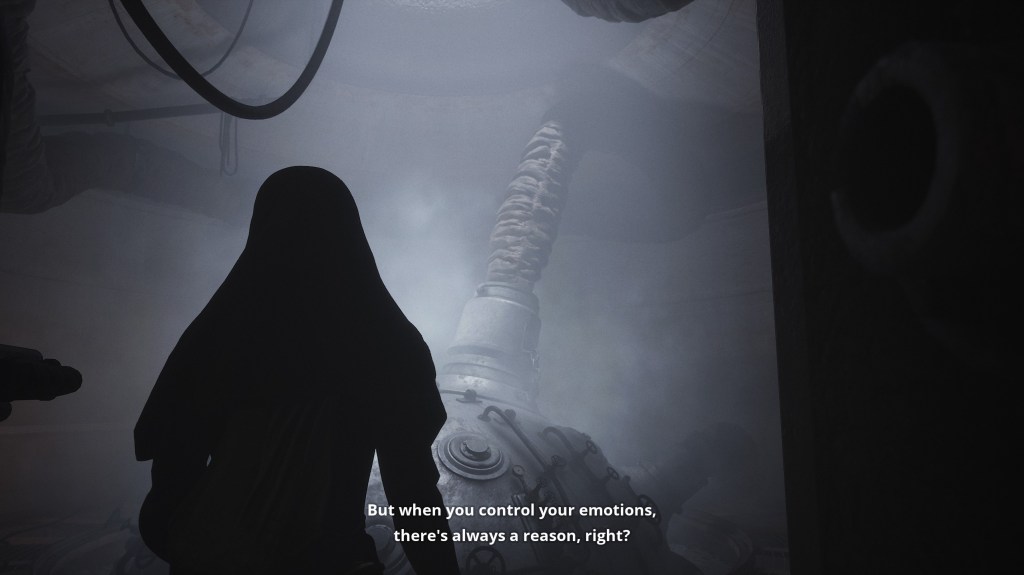
As you make your way to complete the task given to you, you meet a convict on the run, Ilya. Ilya is on the run after a prison train crashes and his goal is to make it to some religious artifact that is touring the country to heal himself. Indika sees a chance to get rid of this voice in her head and also maybe become a better nun, more worthy.
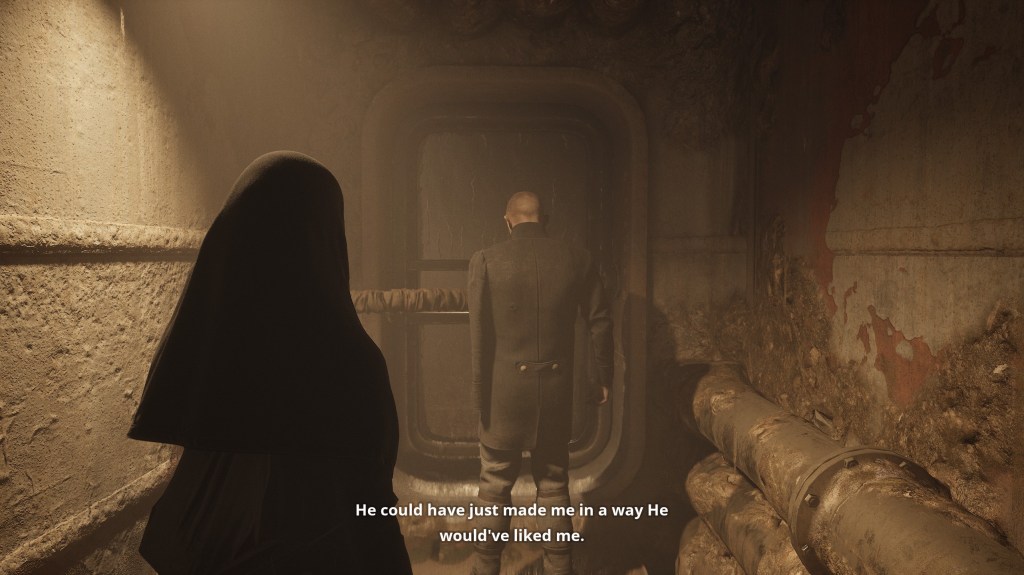
Here is where the game dissects its views on religion and I think it’s done in a way that I preferred. Religion is such a hard topic to get right, because it has a ton of built in bias. If you’re writing about religion, you’re either for or against it, you’re not spending time to write about it if you’re ambivalent. But what I think Indika does well is it questions it in a way that doesn’t shot it down, but more just nudges against it. The core conversation around religion in this game is what is the point of choice if I’m supposed to chose the morally good option every time? Why was I brought to this earth to make a choice if the explained alternative is pain and suffering? Doesn’t that make the choice meaningless at that point? If there is a God that says choose this path and you get to be with me and if you don’t well…you have to go somewhere that is just horrible, but I can’t help you if you go there, that is a hard pill to swallow. Which, I’m sure those that do believe have explanations around divine plans or how it’s meaningful to make those decisions or a dozen other different interpretations. What Indika does well is that it offers it purely as Indika’s view, sure that’s probably the developer’s view because they made the game and the game definitely skews towards that narrative, but I don’t think it’s trying to change anyone’s mind. It wants to say its piece and leave it there.
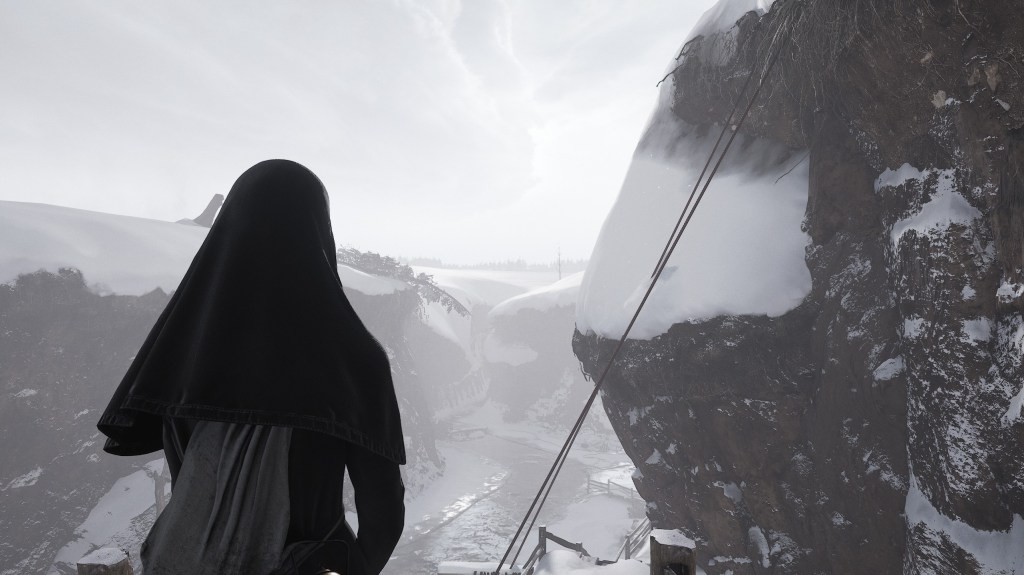
The ending to this game is was tough, I won’t spoil it here, but it’s tough not because of a gameplay mechanic or something that might be unnerving to watch. The final scene has no violence, no grand speech. It simply shows Indika, this character you’ve been following after she’s been fully revealed and put through all sorts of ordeals, and it just has her see the world for what it is and just have to…stand in it. The ending to this game sold me on the whole experience. Because some games would try to give you a nice package of she got a happy ending or she didn’t but she’ll move on from here. The ending was bold in that it pulled no punches and then didn’t let you have a soft landing. You see Indika hit with a hard realization and then…credits.
This game was short, this game was interesting and I think while it might not be for everyone, I’m glad it came out. If the argument is that games are art, we need to remember that sometimes art is difficult, it’s not pretty, but it tries to make you feel something. Sometimes I feel like the games that get called art, are only called that for visuals. Story is mentioned sometimes, sure, but we still can’t tell a story in bigger games without having to commit violence through that journey. The story here talks about a topic at a smaller scale in a more personal tone and it’s a tough topic not addressed outside of having to play as a God or having to deal out justice to a crazy cult. I’m glad I took the chance on it.

 Playthrough
Leave a comment